Sunday, June 21, 2015

MCAT Math Advice

Do you know that you can make ‘magic’ with numbers on the MCAT? 
First of all, know that your power comes from being efficient and by using pattern recognition. 

1. For example, even with no context whatsoever, if you see 44.8 l or 11.2 l on the MCAT, your Pavlovian response should be: "I'm dealing with 2 moles (or 1/2 a mole) of a gas at STP." 
Without reading the question, you recognize a multiple of 22.4 l (the molar volume, Avogadro's Law). Anything times 10 to the power of 23, instantly brings to mind Avogadro's number of particles (a multiple or fraction thereof). 
It does not mean that 100% of the time the answer will depend on your Pavlovian response! We are looking at trends, likelihoods that occur rather often for those minority of questions that are number based. 
Have you seen these numbers on some AAMC exams: 1.44, 1.69? Do they ring a bell? You should have memorized all squares between 1 and 15. You likely have 1 to 10 stone cold! 11 squared is 121, 12 -> 144, 13 -> 169, 14 -> 196, 15 -> 225. They choose their numbers carefully. The moment you see 1.44 on the MCAT, there is a high likelihood that you would be required to take the square root which gives 1.2. Pattern recognition. 


2.  A little blast from the past: pi is 3.14, root 2 is 1.4, root 3 is 1.7. Do not be surprised if you need to calculate the perimeter (2 pi r) or area (pi r squared) of a circle. Be comfortable estimating the root of anything! Root 17? Well, the answer must be between 4 and 5 but closer to 4. Check the answers and do not calculate anything if there is only one answer that is between 4 and 4.5. 


3. Avoid decimals until you have no choice. Fractions will usually permit you to be more efficient. For huge and tiny numbers, you need to be comfortable with scientific notation. If you can hang on to variables for as long as possible, that's even better. You may be surprised how many times mass m ends up being irrelevant as it happily cancels out!  
Feel free to share the above information to other students. 
Good luck with your studies!

LINKS
MCAT Prep Courses
MCAT Practice Tests

Labels: , , , , ,

Wednesday, March 25, 2015

MCAT personal notes: your ticket to higher MCAT scores


Preparation for the new MCAT would require integration. You will be required to have a solid grasp of fundamental definitions and concepts and know how these concepts come together in the life processes of living organisms. Then, you must be able to integrate one’s knowledge and use it to reason.
Thus, you will definitely need quality prep materials and a disciplined study schedule (3-6 hours a day for 3-6 months) to get a high MCAT score and to be accepted to medical school.
However, there is also another important part of your review: your MCAT personal notes.
Your notes will ensure that you avoid the mistake of overstudying or understudying. With note taking, you can maximize the benefits of your content review, practice problems and full-length exams.
A chapter review would result in one to two pages of notes. Every line you read, ask yourself: do I know this already? is this related to something else I read? is this really relevant to the MCAT? Your notes shall focus on the most relevant and new information. For example, if you have noticed a derivation of the Ideal Gas Equation, include that in your notes if it was something new for you.
Also, focus on information that you want to retain as well as keywords and concepts.
Taking notes after taking a full-length MCAT practice test is also important. These notes will make sure that you do not repeat the same mistake. Then, review your notes before taking another test.
Read your notes two to three times per week and then everyday in the weeks leading up to the exam. Research has shown that reading your notes every day improves information recall.
These notes will be your most precious review tool in the days leading up to the real MCAT. Good luck!

LINKS
MCAT Prep Courses
MCAT Practice Tests
MCAT Preparation Advice


Labels: , , , ,

Wednesday, October 29, 2014

MCAT scoring and preparation

The MCAT is composed of four sections – (1) Biological and Biochemical Foundations of Living Systems; (2) Chemical and Physical Foundations of Biological Systems; (3) Psychological, Social, and Biological Foundations of Behavior; and (4) Critical Analysis and Reasoning Skills.
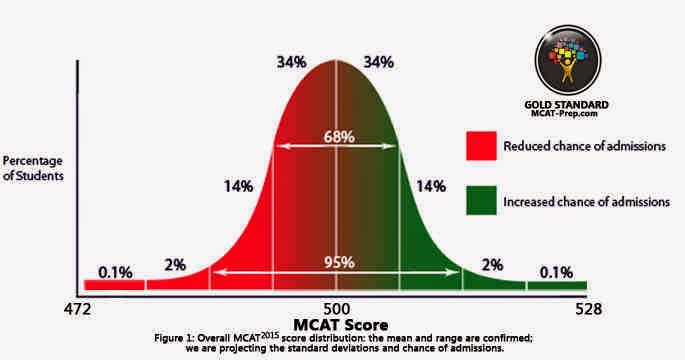
Each section is scored from a low of 118 to a high of 132, with 125 at the center (i.e. the mean or average new MCAT score). The total score will result from a combination of these sections’ scores. The total score will range from 472 to 528, with 500 at the center.
Example:
118 – score for Biological and Biochemical Foundations of Living Systems
130 – score for Chemical and Physical Foundations of Biological Systems
125 - score for Psychological, Social, and Biological Foundations of Behavior
122 – score for Critical Analysis and Reasoning Skills
495 – total score


Examinees will be given a score report that shows percentile ranks so that the student will know how he/she fared compared to others, confidence bands (intervals) that show the ranges where one’s true scores lie and score profiles that show one’s strengths and weaknesses in the four sections. It is difficult to predict how or if the issue of confidence intervals would be used to develop medical school admissions criteria.

Try Out: Medical School Admissions Calculator Based on GPA and MCAT Score

MCAT Sections
So, what are the concepts that each MCAT section will test and what college courses would prepare a student best? Here they are:
Section: Biological and Biochemical Foundations of Living Systems
Will test: concepts related to processes that are unique to living organisms.
College courses to take: Introductory Biology (two semesters), General Chemistry (two semesters), Organic Chemistry (two semesters), Introductory Physics (two semesters) and Biochemistry (first semester).

Section: Chemical and Physical Foundations of Biological Systems
Will test: concepts related to the mechanical, physical and biochemical functions of tissues, organs and organ systems in living organisms.
College courses to take: Biochemistry (first semester), Introductory Biology (two semesters), General Chemistry (two semesters), Organic Chemistry (two semesters) and Introductory Physics (two semesters).

Section: Psychological, Social and Biological Foundations of Behavior
Will test: your knowledge on psychological, sociological and biological factors that influence human perceptions and reactions as well as behavior and changes in behavior.
College courses to take: Introductory Psychology (one semester), Introductory Sociology (one semester) and Introductory Biology (two semesters)

Section: Critical Analysis and Reasoning Skills
Will test: your knowledge on principles in social sciences, philosophy, ethics and popular health
College courses to take: Ethics, Philosophy, Cultural studies (example: History, Anthropology) and Popular Health

While the above courses are important for MCAT prep, using a problem-based learning approach would improve a student’s MCAT scoring. Some helpful review materials are MCAT books, and videos. In addition, MCAT practice tests will allow you to apply what you learned in a timed environment.

Labels: , ,